
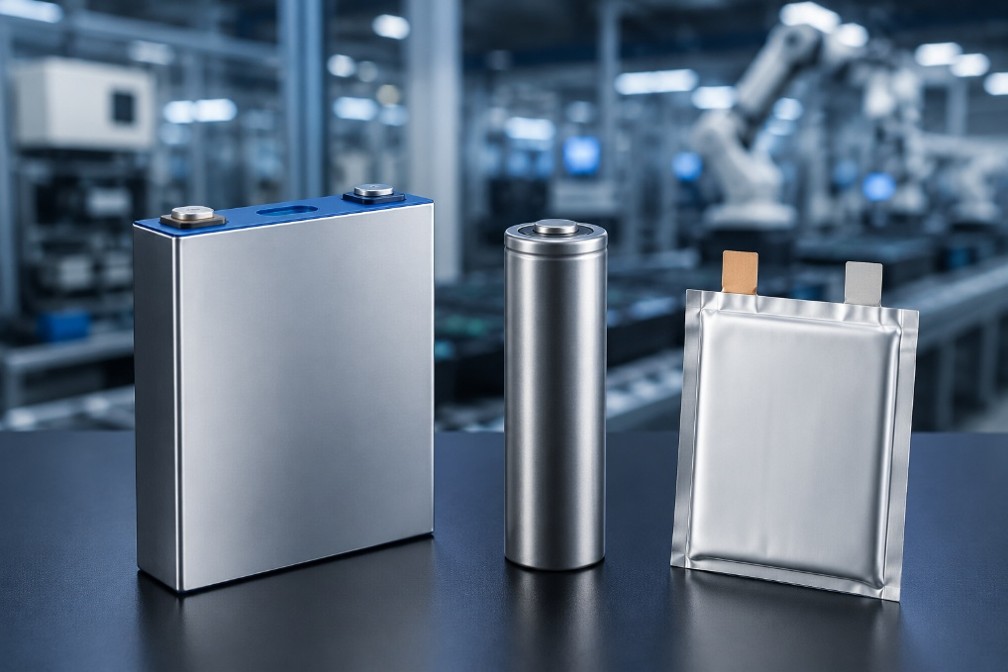
At The Battery Show Europe 2026 in Stuttgart, we asked battery manufacturing equipment suppliers a simple question: Which cell format is most likely to dominate the market in the long term?
The answer has significant implications for the industry. It influences which manufacturing technologies equipment suppliers invest in, how OEMs design their platform and battery pack architectures across future vehicle generations, and which strategic bets suppliers are making with their current investments.
The question itself is not new, and neither was one representative response:
“Predicting that is like picking lottery numbers.”
Prismatic, cylindrical or pouch? No dominant battery cell format has emerged yet
Despite massive investments in battery cell manufacturing worldwide, there is still no clear consensus on whether prismatic, cylindrical, or pouch cells will emerge as the dominant format of the future.
Current market data points to the strong position of prismatic cells. According to the International Energy Agency (IEA), more than 60% of battery cells used in electric vehicles and most stationary energy storage systems today are based on prismatic designs.
However, recent strategic decisions by OEMs highlight the diversity of approaches across the industry. Volkswagen is pursuing standardization through the prismatic unified cell developed by its battery subsidiary PowerCo, which entered series production in Salzgitter at the end of 2025. Chinese manufacturers such as CATL and BYD continue to scale prismatic cell production as well.
At the same time, BMW and Tesla remain committed to cylindrical cell technologies, including the 4680 and broader 46XX formats. Pouch cells continue to play an important role for Korean battery manufacturers such as LG Energy Solution and SK On, as well as for vehicle manufacturers including Hyundai and Kia, where the format remains integral to several vehicle platforms.
Cell chemistry and cell format: a close relationship
Cell chemistry is one of the key factors shaping the competition between battery formats.
LFP batteries and prismatic formats currently complement each other particularly well. The high thermal stability of LFP chemistry supports larger cell formats and facilitates integration into Cell-to-Pack architectures.
NMC chemistries, in contrast, are largely format-neutral and are widely used across prismatic, cylindrical, and pouch cell designs.
Even among emerging battery technologies, no clear format trend has yet emerged. Sodium-ion batteries are often developed in either prismatic or cylindrical formats, largely because existing manufacturing processes can be leveraged. Solid-state battery development remains open as well. Volkswagen and QuantumScape, for example, are working toward integrating future solid-state technologies into the unified cell architecture.
Key takeaways from our discussions
- Format diversity remains the market reality. Demand for production equipment supporting all three cell formats remains strong, with no clear signs of convergence.
- Prismatic cells continue to gain momentum. Cell-to-Pack concepts, LFP chemistries, and standardization strategies pursued by major OEMs make them particularly attractive for high-volume applications.
- Pouch cells remain highly relevant. Their packaging efficiency and design flexibility continue to make them a preferred option for many battery and vehicle manufacturers.
- Investment in cylindrical cells remains strong. Highly automated manufacturing processes, economies of scale, and strong performance characteristics ensure their continued importance, particularly in performance-oriented applications.
- Flexibility is becoming a competitive advantage. Equipment manufacturers capable of supporting multiple cell formats through modular production concepts are well positioned as long as the format race remains unresolved. Suppliers face the challenge of supporting several cell architectures simultaneously, but they also benefit from continued investment across different manufacturing approaches.
One conclusion stood out throughout our conversations at the exhibition: the industry is investing aggressively in expanding battery manufacturing capacity, yet a clear winner in the competition between prismatic, cylindrical, and pouch cells is still nowhere in sight.
We would be interested to hear your perspective on this topic and would be happy to share our own insights. Please feel free to get in touch.
Johannes Sonntag
+49 6201 9915 64
Johannes.Sonntag@SchlegelundPartner.de
© Schlegel und Partner 2026