
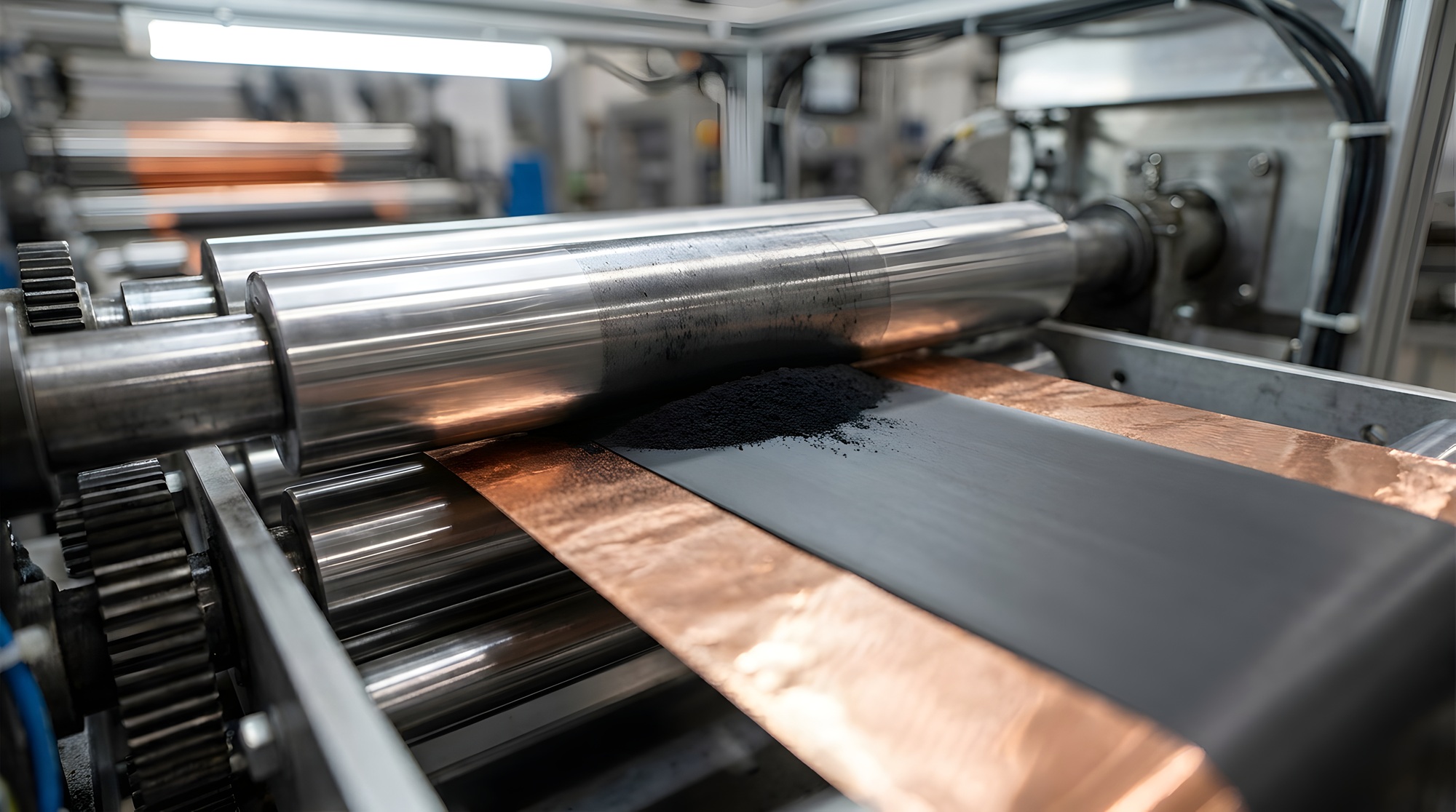
Dry coating of electrodes is considered one of the most promising innovations in battery production. It offers significant potential for substantial cost reductions, reduces the required manufacturing footprint, and eliminates the use of critical solvents (NMP). Against this backdrop, the industry is less focused on if the technology will be adopted, and more on when it will achieve industrial-scale deployment.
At present, dry electrode coating is receiving significant attention following Tesla’s announcement at the beginning of the year regarding the commercial deployment of dry coating in industrial-scale production of both cathodes and anodes in Austin.
Despite these impressive announcements, many market experts remain skeptical as to whether the technology is really already fully mature at industrial scale and capable of delivering all expected benefits. At the same time, there is broad consensus across the industry regarding its long-term potential. In addition to Tesla, other key players such as PowerCo, LG Energy Solution, and Samsung SDI are actively working on the further development of related dry-process technologies.
However, several core challenges in dry coating of electrodes remain unresolved. These include achieving uniform coating distribution and controlled fibrillation at high production speeds, ensuring material compatibility of new binder systems, and reliably scaling processes from laboratory to gigawatt-scale production. Integrating dry coating into existing production lines also remains complex, as manufacturing steps must be fundamentally redesigned. Even if the technical challenges are solved, market adoption is expected to be gradual, as manufacturers are tied to significant prior investments in existing solvent-based production equipment.
As a result, current efforts are strongly focused on pilot lines, process optimization, and validating real-world performance advantages under industrial conditions. These developments create opportunities for new entrants to bring enabling products and technologies into the market. At the same time, they pose long-term risks for existing suppliers, as demand for products such as binders, solvents and wet-coating equipment is likely to shift significantly with the transition to dry electrode.
Schlegel and Partner supports companies in this environment through in-depth market research, innovation analysis, and strategic assessment across the entire value chain. This includes technology scouting, matchmaking for R&D collaborations, and evaluating market potential and investment logic in battery technologies.
Are you interested in further information?
We are happy to support you:
Thorsten Leupold
Phone number +49 6201 9915 16
thorsten.leupold@SchlegelundPartner.de
Ahmad Sisouno
Phone number +49 6201 9915 63
ahmad.sisouno@SchlegelundPartner.de
Dr. Thorsten Bies
Phone number +49 6201 9915 77
thorsten.bies@SchlegelundPartner.de
© Schlegel und Partner 2026