
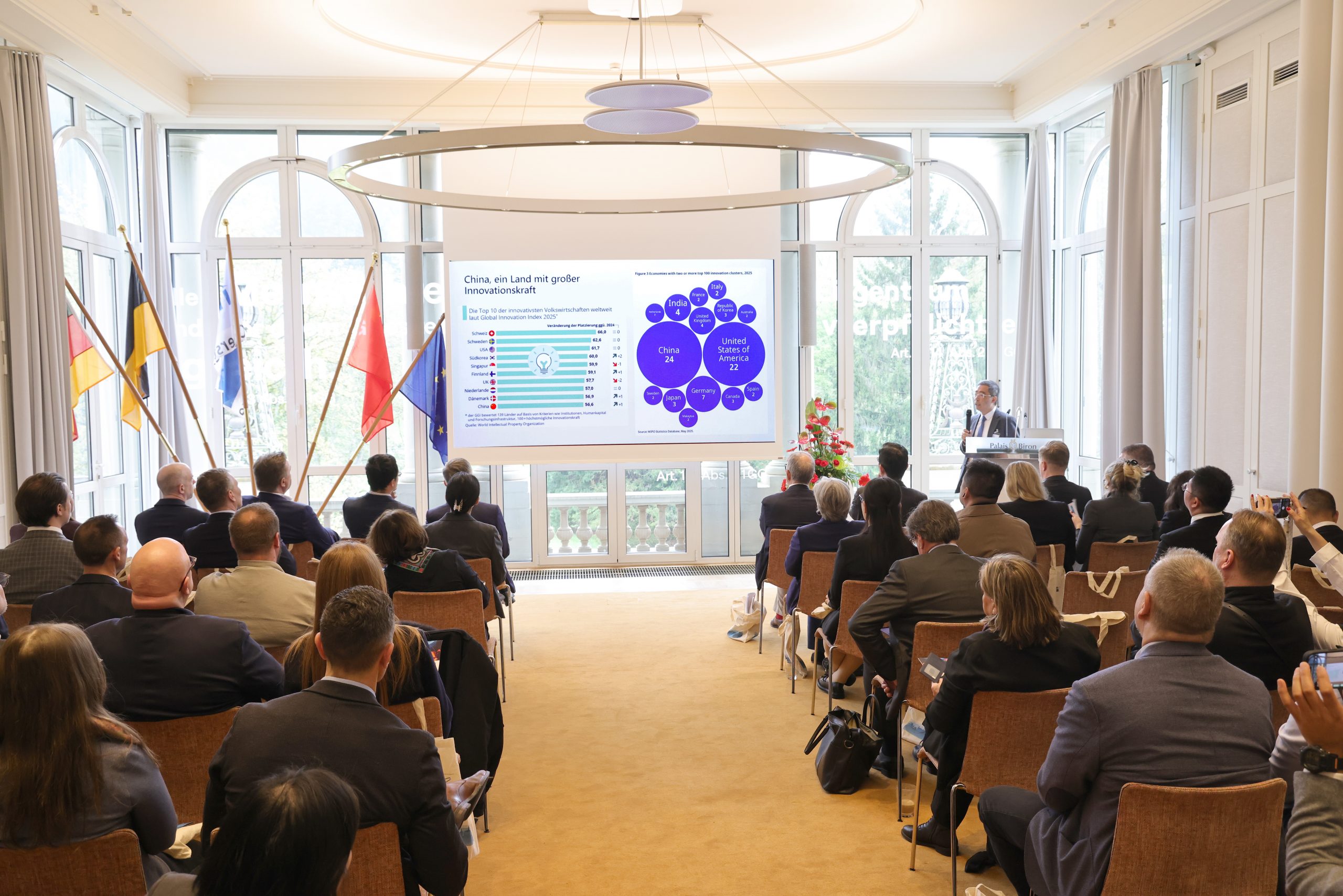
Schlegel and Partner participated in April in the 1st China Forum of the IHK Karlsruhe in Baden-Baden. The event provided a platform for leading experts from business, industry, politics, and international trade to share insights, exchange experiences, and discuss practical strategies for doing business in and with China. The program included keynotes, expert presentations, deep dives, and workshops, as well as ample opportunities to connect with China experts and industry representatives.
At the heart of the China Forum 2026 was the question of how to maintain dialogue in geopolitically challenging times. Equally important was the willingness to learn from one another and jointly develop solutions. The Chinese Consul General emphasized in his opening speech Germany and China should not primarily consider each other competitors, but as partners with complementary strengths. Germany’s strong Mittelstand (medium-sized family-owned enterprises) combined with China’s innovation dynamics opens diverse market opportunities. A Chinese proverb, he cited, captured this idea: “It is not a single flower that brings spring, but the diversity of flowers.”
The Head of the Economic and Commercial Section of the Chinese Consulate General also used a vivid metaphor, describing China as a “gym” for German companies—where they can train their adaptability and innovative capabilities and emerge stronger in the long term.
From a consulting perspective, this view is confirmed: China remains a demanding yet opportunity-rich market. More transparent regulatory frameworks, a strong industrial base, significant market potential, and high innovative capacity continue to create attractive opportunities for German companies. At the same time, China is increasingly evolving from a sales market into a strategic partner and innovation hub.
The discussion of the current Five-Year Plan highlighted that China today is less centrally controlled and more strategically guided. The focus lies on technological self-reliance, industrial modernization, strengthening domestic demand, and green transformation. For German companies, this means that local market knowledge, technological expertise, and strong on-the-ground partnerships are critical. Opportunities arise, among others, in the modernization of agriculture and the further development of industrial value chains.
Despite global tensions, China remains a key market. Diplomatic channels have reopened and trade flows remain resilient, offering businesses some stability – an assessment also echoed by officials at the forum.
While politicians and media in Germany remain wary of China and still call for a partial decoupling, German companies operating in China are broadly optimistic about their future. Successful German companies in China act faster, operate more locally, and continuously expand their market knowledge alongside a more reciprocal relationship in which German firms increasingly learning from China.
Although “China-bashing” remains common in Germany, the China Forum emphasizes collaboration and mutual learning as key for the future relationship of the two countries. At the same time, structural imbalances, regulatory differences, economic security concerns as well as market distortions through Chinese subsidies also remain key concerns in German–Chinese ties in 2026.
Our conclusion: Germany and China remain closely interconnected economically. Success depends on a pragmatic; long-term approach combined with a solid understanding of local markets in China. German companies should remain open to cooperation—while maintaining a clear view of risks, regulatory requirements, and strategic dependencies. Networks, knowledge exchange, and sound advisory support are key success factors.
Are you interested in further information?
Please do not hesitate to contact us:
Dorothea Slevogt
+49 6201 9915 76
Dorothea.Slevogt@SchlegelundPartner.de
Picture source: IHK Karlsruhe
© Schlegel und Partner 2026