
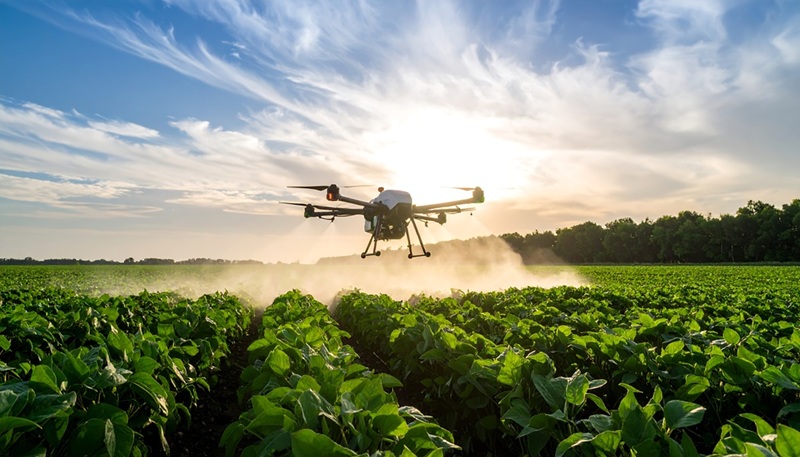
Brazil is rapidly reinventing its farming sector. Precision agriculture, AI-driven tools, and strict sustainability standards are reshaping the industry—opening a vast window of opportunity for technology providers and investors seeking scalable, future-ready markets.
Brazil has solidified its role as a central pillar of global food security, ranking among the world’s leading suppliers of soybeans, corn, beef, poultry, sugar, coffee, orange juice, cotton, and forestry products. The sector is evolving beyond a purely scale-driven model toward one shaped by technology intensity, efficiency, and sustainability standards, creating strong opportunities for investors, solution providers, and strategic partners.
This strength is supported by vast arable land, favorable climate conditions, and increasingly sophisticated farming operations—particularly in the Center-West and South. Other regions contribute through livestock, fruit production, regional crops, and sustainable forestry, enabling multiple production cycles per year and reinforcing the resilience of global supply chains. Around this base thrives a robust ecosystem of processing industries, export infrastructure, and value-added chains.
Brazil’s agricultural competitiveness is anchored in advanced mechanization, world-class research capabilities, and the rapid expansion of agritech solutions—factors that continue to elevate productivity and reinforce the country’s relevance in the global economy.
Biologicals: Brazil as a Global Growth Engine
Brazil has rapidly emerged as one of the most dynamic markets for agricultural biologicals, including biopesticides, biofertilizers, and bio-stimulants. While still smaller than conventional chemical inputs in absolute terms, this segment is expanding well above the global average, driven by growing adoption in large-scale crops such as soybeans, corn, sugarcane, and coffee.
Recent estimates place the Brazilian biologicals market at approximately US$ 800 million, with projections of around US$ 1.1 billion by 2030, supported by an above-average CAGR over the next five years. Biofertilizers and bio-stimulants stand out as the fastest-growing categories, reflecting the broader shift toward sustainable and performance-driven production systems.
This momentum is fueled by Brazil’s tropical conditions, increasing resistance to traditional agrochemicals, stricter residue and environmental regulations, and rising sustainability demands from international markets. As a result, Brazil has become not only a major consumer of biologicals, but also a critical testing and scale-up platform for next-generation solutions.
Supported by strong research institutions, agritech startups, and multinational investments, biologicals are transitioning from a niche alternative to a core component of modern crop management, increasingly integrated with precision application, digital platforms, and traceability systems.
The Agro-tech trend: Agriculture 4.0
The transition toward Agriculture 4.0 is accelerating and increasingly essential for maintaining competitiveness.
Precision agriculture:
AI-driven analytics, satellite imagery, drone mapping, soil sensors, and variable-rate technologies allow farmers to apply fertilizers, biologicals, and crop protection products with extreme accuracy. This reduces waste, lowers production costs, minimizes environmental impact, and maximizes yield per hectare — a critical factor in meeting global demand without expanding agricultural land use.
Biotechnology:
plays an equally strategic role. Genetically improved seeds, increasingly developed through partnerships between multinational firms and Brazilian research institutions such as Embrapa, are designed to perform under the country’s highly diverse climate conditions. These technologies improve resistance to pests, drought, and diseases, while also enhancing nutrient use efficiency — creating a natural bridge with the rising adoption of biologicals as part of integrated crop management systems.
Digitalization:
Brazilian agritech startups are developing platforms that integrate climate data, soil health indicators, machinery performance, and supply-chain logistics into unified decision-making systems. These tools enable predictive analytics for planting, harvesting, irrigation management, and risk mitigation, transforming farms into data-driven operational hubs.
Conclusion
Brazilian agribusiness is entering a new phase in which scale, technology, and sustainability converge to define global leadership. The rapid expansion of biological and consolidation of Agriculture 4.0 practices signal a structural transformation rather than a temporary trend. Brazil is no longer operating only as a supplier of commodities, but as an innovation environment capable of validating, scaling, and exporting new agricultural models to the rest of the world.
For investors, technology developers, and international partners, this represents a unique combination of opportunity and strategic relevance: access to one of the largest production systems on the planet, increasingly driven by data, efficiency, and sustainability metrics.
Are you interested in further information? Please do not hesitate to contact us.
Ademir Voigt
+49 6201 9915 73
Ademir.Voigt@SchlegelundPartner.de
© Schlegel und Partner 2026